
You sit down with your coffee, open your planner, and stare at the list. Again. The same tasks from yesterday are still there. And somehow, three new ones appeared overnight. You tell yourself, “Today’s the day I finally get ahead.” But by evening, you’ve checked off maybe two items—and added five more.
Sound familiar?
If your to-do list feels less like a productivity tool and more like a monument to everything you can’t seem to finish, you’re not alone. And here’s something important: it might not be about trying harder.
For many people, especially those with undiagnosed ADHD, the problem isn’t laziness or poor time management—it’s how their brain processes tasks, priorities, and time itself.
The Illusion of “Just Getting It Done”
We live in an world that celebrates productivity. Everywhere you look, someone’s sharing their morning routine, their color-coded planner, or their “life-changing” app. The message is clear: if you just find the right system, you’ll finally get control.
But what if the system isn’t the problem?
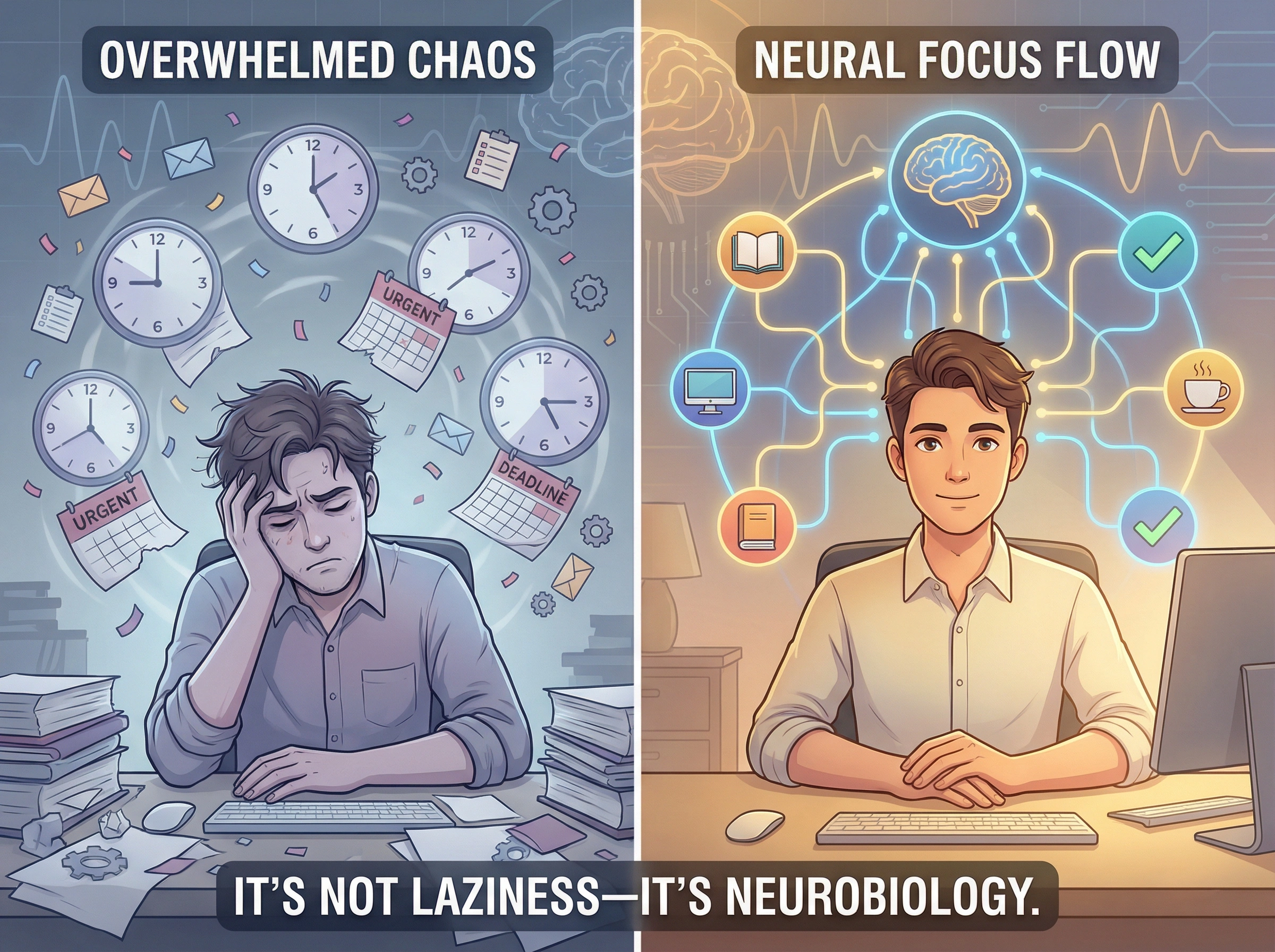
For individuals with ADHD, executive function—the brain’s ability to plan, organize, prioritize, and follow through—works differently. It’s not that you don’t want to tackle your list. It’s that your brain struggles to:
- Decide where to start when everything feels equally urgent (or equally boring)
- Estimate how long tasks will take, leading to chronic over-scheduling
- Maintain focus on tasks that don’t provide immediate reward or stimulation
- Remember what you were supposed to do in the first place
This isn’t a character flaw. It’s neurobiology.
The Hidden Culprits Behind the Never-Ending List
1. Time Blindness
People with ADHD often experience what’s called “time blindness”—a difficulty perceiving how much time has passed or how long something will take. You might think a task will take 20 minutes when it actually takes two hours. Or you underestimate how long your morning routine takes, making you perpetually late and perpetually behind.
When you can’t accurately gauge time, your to-do list becomes a fantasy document—packed with more than any human could accomplish in a day, let alone someone juggling focus challenges.
2. Task Initiation Paralysis
Ever stare at a simple task for hours, unable to start? That’s task initiation difficulty, a common ADHD symptom. Your brain needs a certain level of stimulation or urgency to “activate.” Without it, even easy tasks feel impossible to begin.
So items sit on your list. Days turn into weeks. The guilt builds. And instead of shrinking, your list grows—because life keeps happening while you’re stuck at the starting line.

3. The “All or Nothing” Trap
Many people with ADHD fall into black-and-white thinking about productivity. If you can’t do something perfectly or completely, why start at all? This perfectionism, combined with difficulty breaking large tasks into smaller steps, means projects stay on your list indefinitely.
That “organize the garage” task from three months ago? Still there. Because in your mind, it’s one massive, overwhelming job—not 15 smaller, manageable actions.
4. Emotional Overwhelm and Avoidance
Tasks that trigger anxiety, boredom, or frustration get pushed to the bottom of the list. But they don’t disappear. They lurk there, creating a low-level stress that makes it even harder to focus on anything else.
Before you know it, you’re avoiding your entire list because just looking at it feels overwhelming.
5. The Dopamine Factor
ADHD brains have lower levels of dopamine, the neurotransmitter that drives motivation and reward. Your brain is constantly seeking stimulation, which means:
- Urgent tasks get done (hello, adrenaline!)
- Novel tasks get done (new = interesting!)
- Boring-but-important tasks get ignored
So your list fills up with the mundane essentials—paying bills, scheduling appointments, responding to emails—while your brain chases whatever feels more immediately rewarding.
It’s Not About Trying Harder
Here’s what we want you to understand at Focused Connections Psychiatry: You are not broken. You are not lazy. Your brain just works differently.
If you’ve spent years feeling like you’re failing at something everyone else finds easy, it’s time to consider that you might be working against your neurobiology instead of with it.
What Actually Helps

Real change doesn’t come from another productivity hack. It comes from:
- Understanding your brain: Getting a proper evaluation can reveal whether ADHD or another condition is at the root of your struggles
- Tailored strategies: ADHD-friendly systems that work with your brain, not against it
- Appropriate treatment: For many, a combination of medication management, therapy, and skills training makes a profound difference
- Self-compassion: Releasing the shame and recognizing that you’ve been fighting an uphill battle
You Deserve Clarity
If your to-do list has become a source of shame rather than a helpful tool, it might be time to explore what’s really going on. At Focused Connections Psychiatry, we specialize in comprehensive ADHD evaluations and personalized treatment plans that address the root causes—not just the symptoms.
You don’t have to keep spinning your wheels. With the right support, you can move from overwhelm to clarity, from stuck to moving forward.
Because you deserve care that truly understands you.
This information is for educational purposes and is not a substitute for professional evaluation or treatment. If you’re struggling with focus, organization, or task completion, reaching out for help is a strong and important step.
Contact Focused Connections Psychiatry today at (562) 312-1777 or click here to schedule your free symptom assessment. Our office is located at 4132 Katella Avenue, Suite 200, Los Alamitos, CA 90720.