Understanding How ADHD Changes Time, Focus, and Motivation
Have you ever sat down to start a simple task, only to find yourself staring at it for hours without making progress? Or maybe you’ve lost track of time so completely that what felt like 20 minutes was actually three hours?
If you’ve ever wondered why your brain seems to work differently than everyone else’s—why focus feels impossible some days and effortless others, or why motivation appears and disappears like magic—you’re not alone, and there’s a real explanation.
At Focused Connections Psychiatry, we work with people every day who describe these exact experiences. Understanding how the ADHD brain processes time, focus, and motivation isn’t just interesting science—it’s the key to finally making sense of patterns you’ve probably been struggling with for years.
The ADHD Brain Isn’t Broken—It’s Wired Differently
First, let’s be clear: ADHD is not a character flaw, and it’s not about being lazy or undisciplined. ADHD (Attention-Deficit/Hyperactivity Disorder) is a neurodevelopmental condition that affects how your brain regulates attention, manages impulses, and processes rewards.
Research shows that ADHD involves differences in brain structure and function, particularly in areas responsible for executive function—the mental skills that help us plan, focus, remember instructions, and juggle multiple tasks.
Think of executive function as your brain’s project manager. For people without ADHD, this manager keeps things running relatively smoothly. But with ADHD, that manager is constantly getting pulled in different directions, struggling to prioritize, and sometimes just not showing up when you need them most.
Time Blindness: When Your Internal Clock Doesn’t Work
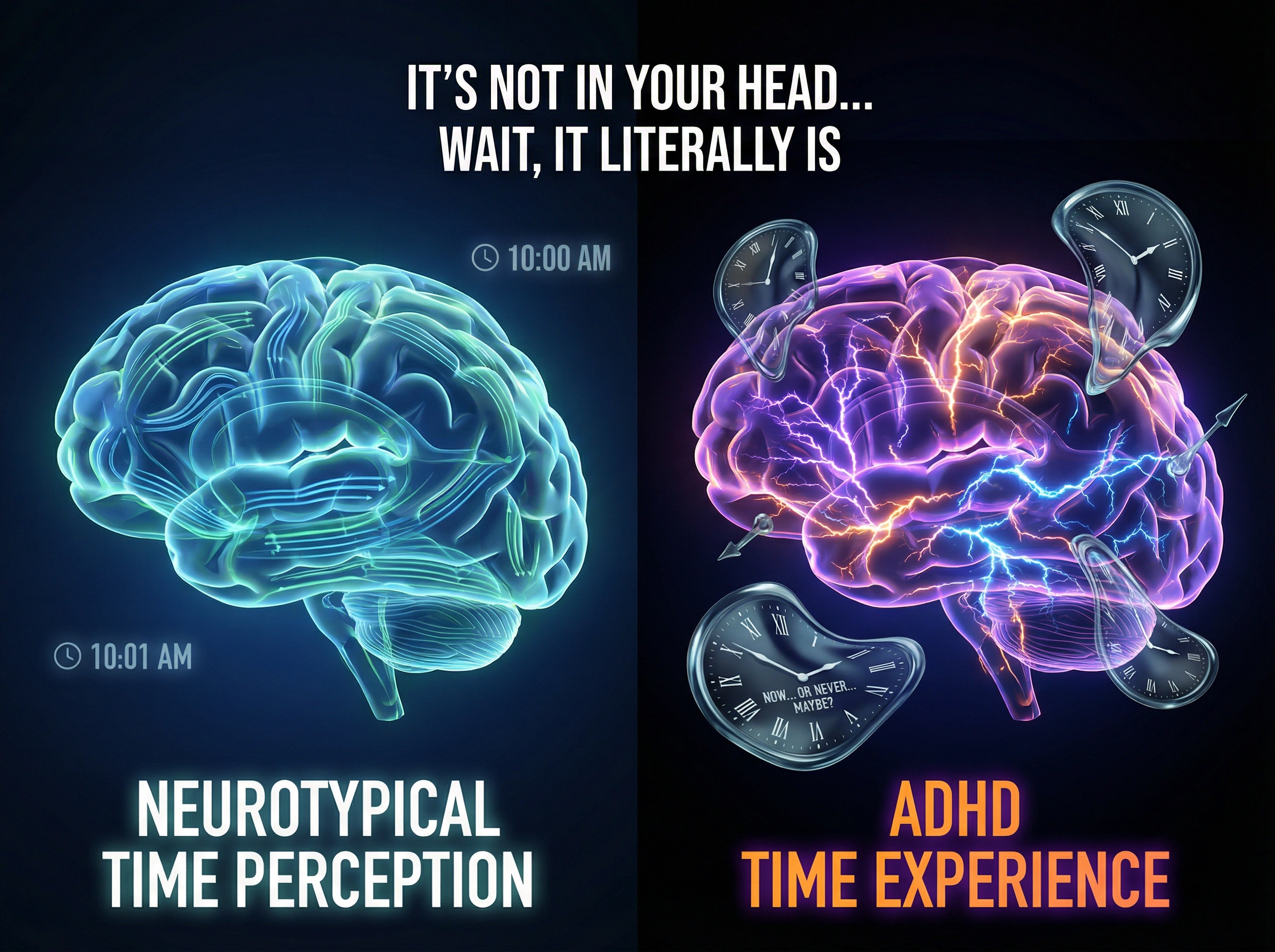
One of the most frustrating aspects of ADHD is something called “time blindness.” This isn’t about being bad at reading a clock—it’s about your brain’s inability to accurately sense the passage of time or estimate how long tasks will take.
You might think you have “plenty of time” to get ready for an appointment, only to realize you’re already late. Or you might avoid starting a project because it feels overwhelmingly huge, when in reality it would only take 30 minutes. This happens because the ADHD brain struggles with temporal processing—the ability to perceive, track, and plan around time.

Many people with ADHD describe living in two time zones: “now” and “not now.” If something isn’t happening right this moment, it might as well be a million years away. This makes planning ahead, meeting deadlines, and showing up on time feel like you’re constantly swimming upstream.
The Focus Paradox: All or Nothing
Here’s something that confuses a lot of people: if you have ADHD, why can you sometimes focus intensely on things you enjoy for hours on end? Shouldn’t ADHD mean you can’t focus on anything?
The truth is more nuanced. ADHD doesn’t mean you have a deficit of attention—it means you have difficulty regulating where your attention goes. Your brain struggles to direct focus toward tasks that don’t provide immediate interest or reward, but it can become completely absorbed (hyperfocused) on activities that are stimulating, novel, or personally meaningful.
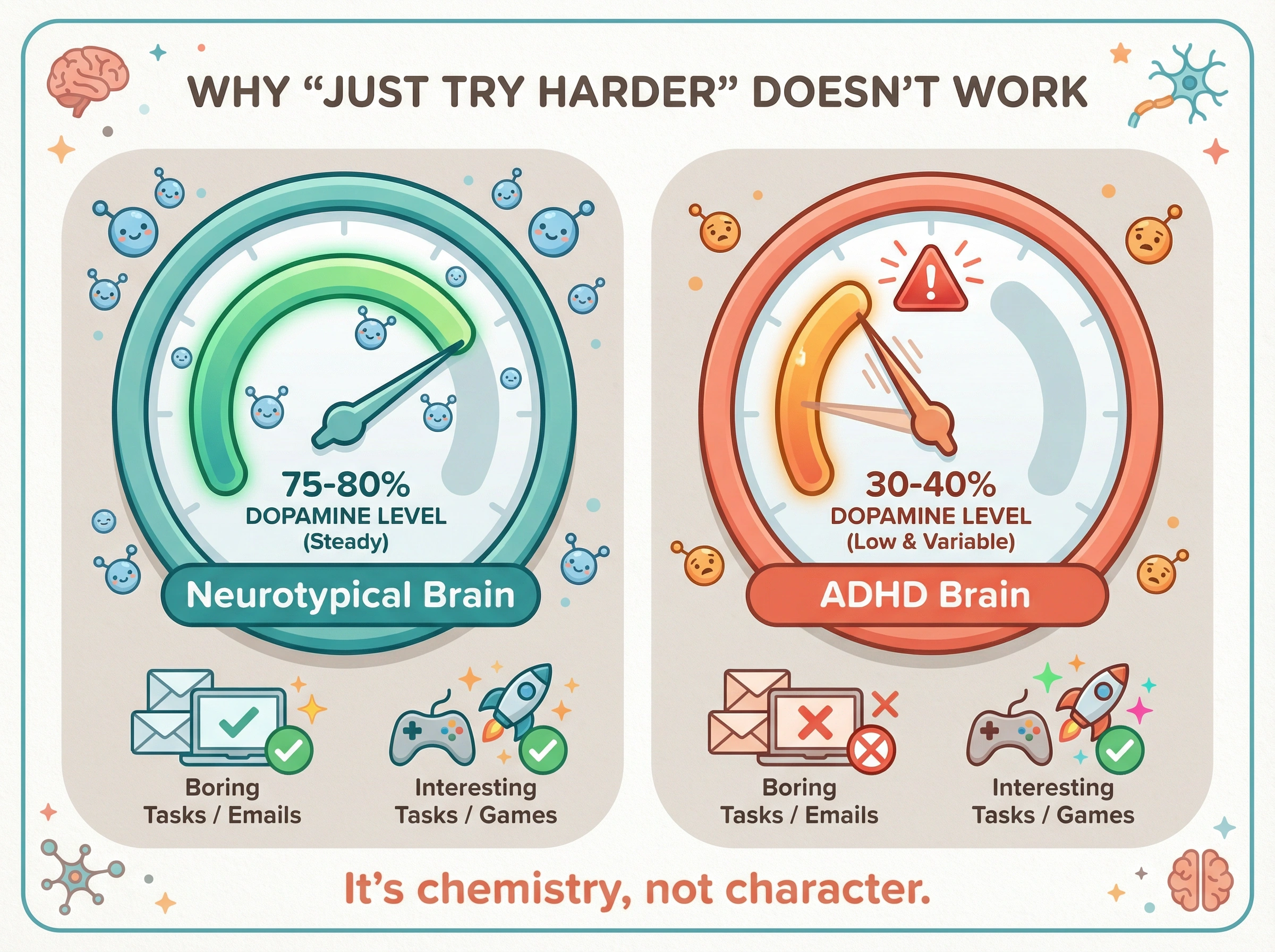
This happens because of differences in how the ADHD brain processes dopamine, a neurotransmitter that plays a crucial role in motivation, reward, and attention. When a task doesn’t naturally trigger enough dopamine, your brain essentially says, “This isn’t worth our energy,” making it feel nearly impossible to start or sustain focus—even when you desperately want to.

The Motivation Mystery: It’s Not About Willpower
If you’ve ever been told to “just try harder” or “just focus,” you know how frustrating and unhelpful that advice is. Motivation with ADHD isn’t about willpower—it’s about brain chemistry.
The ADHD brain has lower baseline levels of dopamine and norepinephrine, neurotransmitters that help regulate attention and motivation. This means that tasks which feel mildly boring to others can feel absolutely unbearable to someone with ADHD. Your brain is literally seeking more stimulation to function optimally.
This is why you might be able to tackle a complex creative project with ease but struggle to respond to a simple email. It’s why you can remember obscure facts about your favorite hobby but forget important appointments.
Your brain isn’t being difficult—it’s working with a different neurochemical baseline.
What This Means for Your Daily Life
Understanding these differences isn’t just academic—it changes everything about how you approach your challenges. When you realize that missing deadlines isn’t about being irresponsible, that time blindness is a real neurological phenomenon, and that motivation struggles are rooted in brain chemistry, you can stop blaming yourself and start finding strategies that actually work with your brain, not against it.
There Is a Path Forward
The good news? With proper evaluation, treatment, and support, people with ADHD can develop systems and strategies that work with their unique brain wiring. This might include medication to help regulate neurotransmitter levels, behavioral strategies to manage time and tasks, and environmental modifications that reduce friction and support focus.
At Focused Connections Psychiatry, we believe in meeting you where you are—no judgment, no shame, just clarity and a personalized plan to help you move forward. If these patterns sound familiar, an evaluation can help you understand what’s happening in your brain and what steps you can take to feel more in control.
This information is for education and support only and is not a substitute for a professional evaluation or treatment. If you’re struggling, reaching out for help is a strong and important step.
Ready to get clarity? Contact Focused Connections Psychiatry today at (562) 312-1777 or click here to schedule your free symptom assessment and discover the support you deserve. Our office is located at 4132 Katella Avenue, Suite 200, Los Alamitos, CA 90720.