Why Your Exhaustion Might Not Be What You Think
You’ve been staring at your laptop for twenty minutes, but you can’t seem to start that report. Your inbox has 247 unread emails. You forgot about that meeting—again. And when your partner asks what’s wrong, all you can say is, “I’m just so tired.”
If you’re nodding along, you’re probably wondering: Is this burnout from too much stress, or could it be ADHD?
Here’s the thing that surprises most people: burnout and ADHD can look remarkably similar on the surface. Both can leave you feeling mentally exhausted, unable to focus, and struggling to keep up with daily responsibilities. But understanding the difference isn’t just about putting a label on what you’re experiencing—it’s about getting the right help so you can actually feel better.
The Burnout Story: When Stress Becomes Overwhelming
Burnout typically develops after prolonged periods of stress, overwork, or emotional strain. It’s what happens when you’ve been running on empty for too long, and your mind and body finally say, “Enough.”
Common signs of burnout include:
- Exhaustion that doesn’t improve with rest. You sleep, but you still wake up tired.
- Cynicism or detachment. Things that used to matter don’t anymore.
- Reduced performance. Tasks that were once manageable now feel impossible.
- Physical symptoms. Headaches, stomach issues, or muscle tension that won’t go away.

The key characteristic of burnout? It usually has a clear timeline. You can often point to when things started feeling this way—maybe after that brutal project at work, during a particularly stressful semester, or after months of juggling too many responsibilities.
And here’s the hopeful part: with proper rest, boundary-setting, and stress management, burnout typically improves. Remove or reduce the stressor, and your brain starts to recover.
The ADHD Story: When Your Brain Has Always Worked Differently
ADHD (Attention-Deficit/Hyperactivity Disorder) is a neurodevelopmental condition that affects how your brain regulates attention, impulses, and activity levels. Unlike burnout, ADHD doesn’t suddenly appear in adulthood because you’ve been stressed—it’s been there all along, even if you didn’t realize it.
Common signs of ADHD in adults include:
- Chronic difficulty focusing, even on things that are important.
- Time blindness. You consistently underestimate how long tasks will take.
- Forgetfulness and disorganization that affects multiple areas of your life—work, home, relationships.
- Restlessness or mental hyperactivity. Your mind feels like it never shuts off.
- Impulsivity in decisions, spending, or conversations (interrupting others, for example).
- Task paralysis. You know what needs to be done, but you can’t make yourself start.
The crucial difference? These patterns have been present throughout your life, even if they’ve become more noticeable or problematic recently. Maybe you were the “smart but disorganized” kid in school. Maybe you’ve always struggled with paperwork and administrative tasks. Maybe you’ve developed elaborate coping strategies that are finally breaking down under increased demands.
The Plot Twist: You Might Have Both
Here’s where things get complicated: ADHD can actually make you more vulnerable to burnout.
When you have ADHD, everyday tasks require more mental energy than they do for others. You’re constantly working harder just to stay organized, meet deadlines, and remember important details. It’s like everyone else is walking on flat ground while you’re climbing uphill—and after years of that extra effort, burnout becomes almost inevitable.
Many adults with undiagnosed ADHD experience cycles of intense effort followed by complete exhaustion. They push themselves to compensate for their ADHD symptoms, achieve some success, but then crash hard. From the outside, it looks like burnout. But the underlying issue—the ADHD—never goes away.
How to Tell the Difference
Ask yourself these questions:
Timeline: Have you always struggled with focus, organization, and follow-through, or did these issues start recently after a period of high stress?
Scope: Do your difficulties show up in multiple settings (work, home, relationships), or are they limited to one stressful area of your life?
Response to rest: When you take time off, do you feel genuinely refreshed and able to focus again, or do the same struggles return immediately?
Childhood patterns: Looking back, were you often described as “scattered,” “daydreamy,” “too energetic,” or “not living up to your potential“?
If your struggles are longstanding, show up everywhere, and don’t improve much with rest, ADHD might be worth exploring.
Why Getting Clarity Matters
Whether you’re dealing with burnout, ADHD, or both, you deserve answers—and more importantly, you deserve support that actually works.
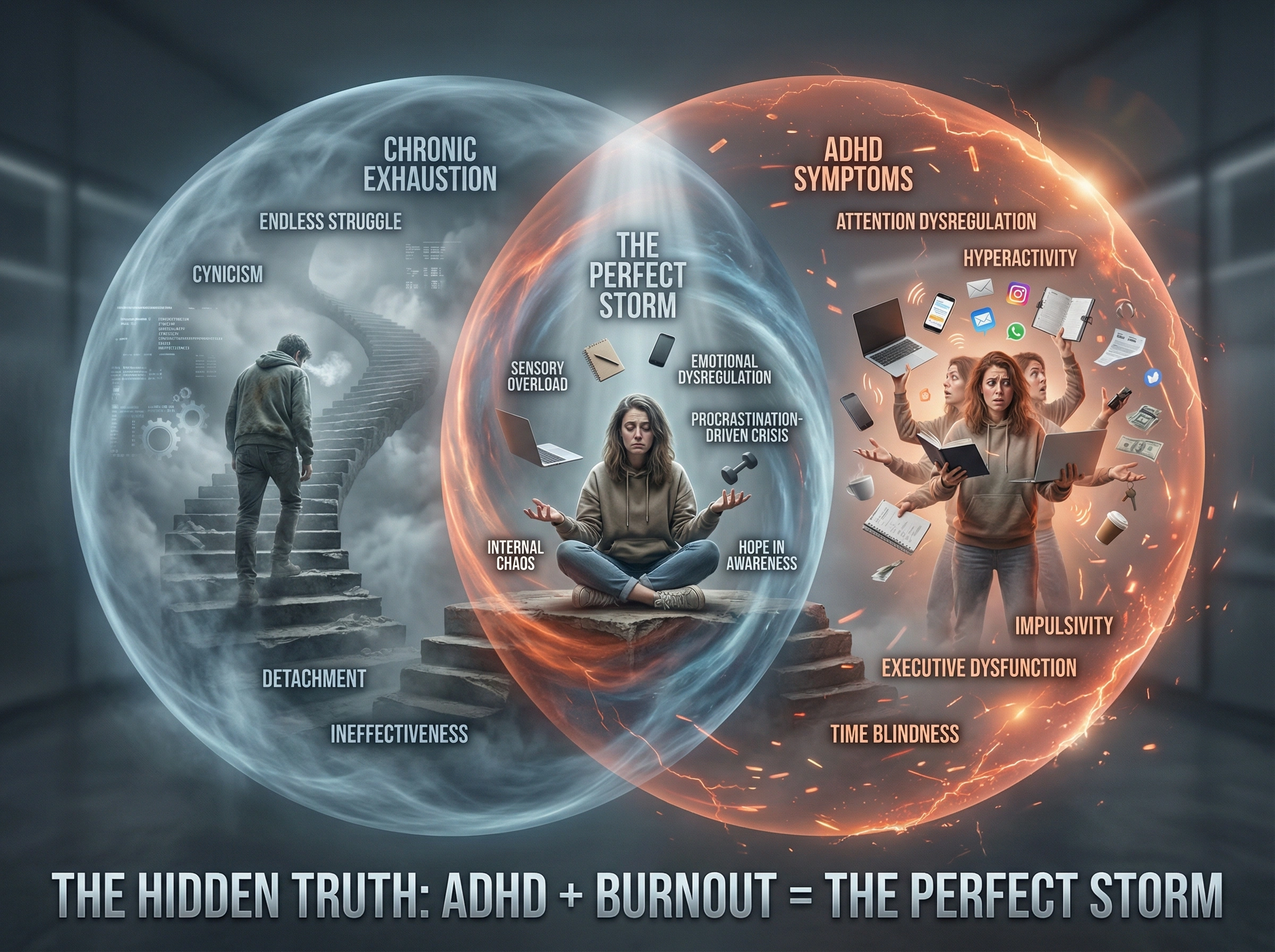
Burnout responds to stress reduction, boundary-setting, and rest. ADHD responds to a combination of strategies: medication management, organizational systems designed for ADHD brains, therapy, and lifestyle adjustments. Treating one when you actually have the other (or both) means you’ll keep struggling unnecessarily.
At Focused Connections Psychiatry, we understand that these experiences can overlap and that sorting them out requires a thorough, compassionate evaluation. We don’t just look at checklists—we look at your whole story, your patterns over time, and what’s actually happening in your daily life.
You’re Not Broken—You Just Need the Right Map
If you’ve been telling yourself you just need to try harder, rest more, or “get it together,” please hear this: you’re not lazy, and you’re not failing. Your brain might just work differently, or you might be genuinely depleted from carrying too much for too long.
The first step toward feeling better is understanding what you’re actually dealing with. And you don’t have to figure it out alone.
If this article resonated with you, consider reaching out for a professional evaluation. At Focused Connections Psychiatry, we provide comprehensive ADHD assessments and personalized treatment plans. Contact us at (562) 312-1777 or click here to schedule a free symptom assessment.